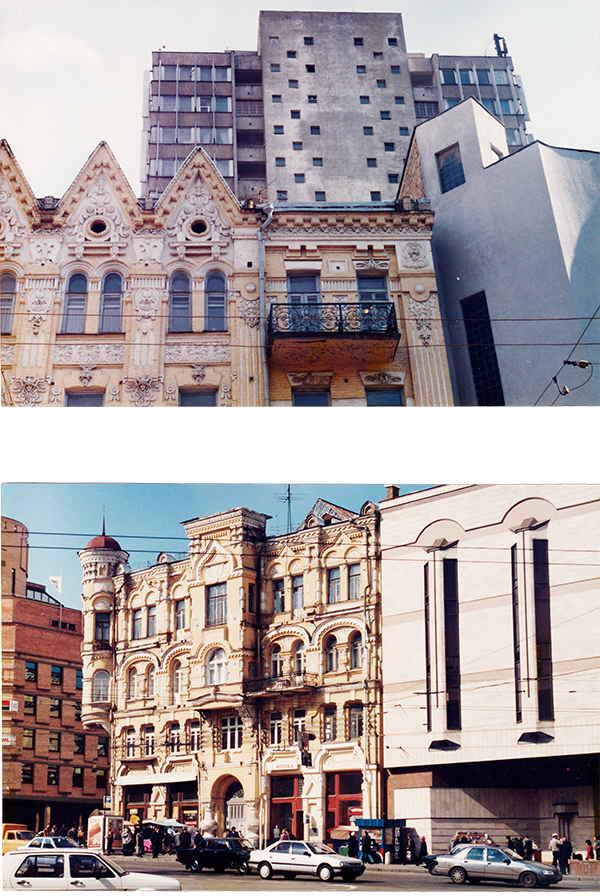
First came the balconies. And then… gradually, my fascination with Kyiv’s
architecture shifted from balconies to the facades of its buildings and to
passages and gates. The incredibly beautiful facades of Kyiv’s townhouses,
with their almost Baroque ornamentation, cornices and details. The gates of
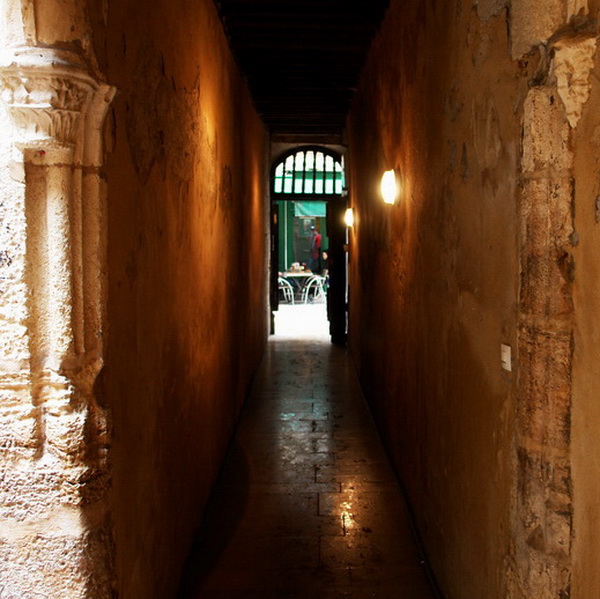
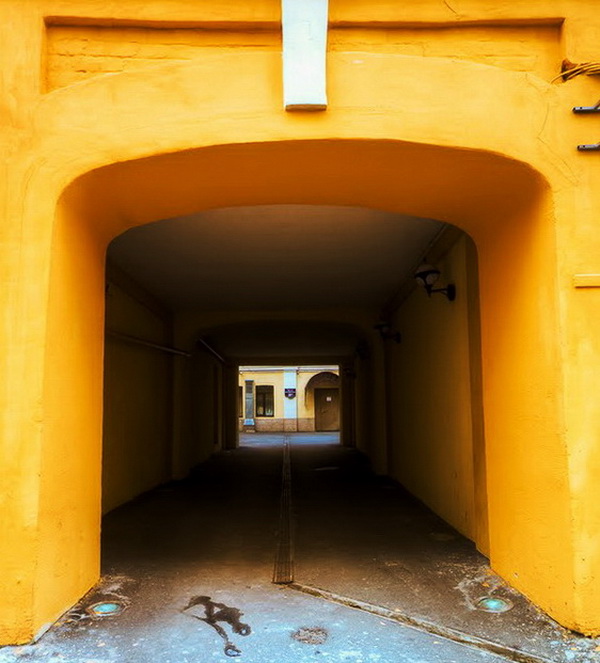
the old townhouses seemed to invite you in, but it was the
passage itself that intrigued me most. It led into a
courtyard, and there, another passage could be seen in the next building.
Oh, what a subject!
To capture the light caressing the gate from within, and the
mystery of what was hidden beyond it. How lucky I was that this was still a
time without barriers and security fences in the city (and with fewer cars).
So Kyiv was once again the first. Then other cities gradually revealed to me
the beauty of their gates and hidden corners. I painted gates in Vilnius,
Lublin, Kraków, Katowice and Chrzanów, and later the architecture of the
German cities of Otterndorf and Stade, as well as Lyon in France.
As I painted them, passages and gates also took on new meanings and
metaphors; they became a passage between what is known and visible and what
is hidden, between light and shadow, good and evil.
Now, after a break, I am returning to painting and rubbing my hands with
delight, because there are so many beautiful places waiting to be painted!
Soon I will tell you which extraordinary city became my first great
inspiration after all these years.
August 10, 2026
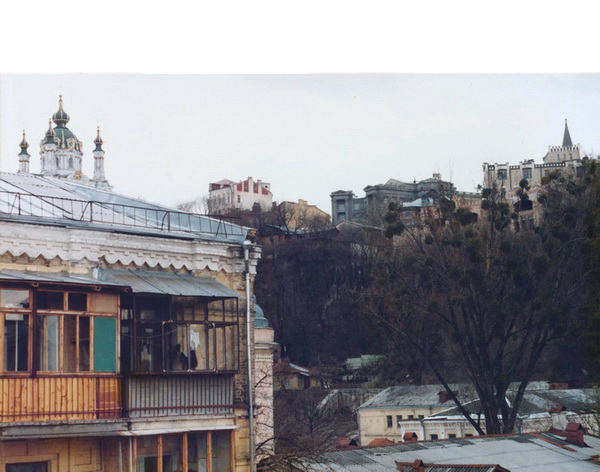
Balconies of Kyiv
This is what I wrote about the Balconies of Kyiv in March 2000:
“A person who is emotionally connected to a particular place carries its image within them,
and certain small ‘snapshots’ in the subconscious create a unique and personal
portrait of the city. This is how it was for me with Kyiv.
Compared with my hometown of Kraków, which is covered with the patina of time
and immersed in sepia, muted browns and greys, Kyiv surprised me with
the vivid colours of house walls, ornaments, and the colourful chequerboard
of balconies built into new buildings, or with the solitude of some balconies
against the vast walls of older buildings. The façades of the buildings here
caught my attention with their ‘otherness’, even their exoticism. (…)
Several years passed before these impressions developed into a concrete idea
of giving them a painterly form.
The series of paintings “Balconies of Kyiv” is a presentation of my impressions, arising from
my astonishment and fascination with the aesthetics of selected architectural elements
of the monumental city of Kyiv. Their beauty moves me, although at times it results
from objective ugliness, decay, repainting, scratches, or even absurd
combinations of forms (from an architect’s point of view).
Józef Czapski wrote about a similar feeling:
“It is the same solitary, unexpected wonder, the feeling that we alone see a miracle
of unique beauty, which in the eyes of others is either completely unnoticed
or – worse still – ridiculous.”
July 21, 2026
The Dream of Red Hair
I prefer white to black. The sun to the moon.
I prefer dogs to cats. Silence is better than noise.
I find Baroque more beautiful than the Renaissance. Summer over winter.
And tall, comfortable cars over low, uncomfortably flat ones.
On the other hand, I prefer low heels to high ones.
Ever since it became possible (henna became available in shops in the 1980s),
I started dyeing my hair red.
July 1, 2026
Give your child the freedom to create.
As a child, I didn’t like the color pink or blue.
When it came to clothes, of course, you couldn’t be picky – you had to wear what you had.
My grandmothers sewed dresses and knitted, and later – probably from the age of 13 –
I started sewing for myself, knitting various things, making patchwork skirts, sweaters,
bags, and dyeing fabrics.
My parents gave us the freedom to be creative. For example, my younger sister
and I were allowed to paint on the walls of the room we shared – once it was a dragon,
and later a painted brick wall.
It was great.
However, this didn’t mean “do whatever you want” – there were boundaries,
and we knew what each of us was allowed to do and when.